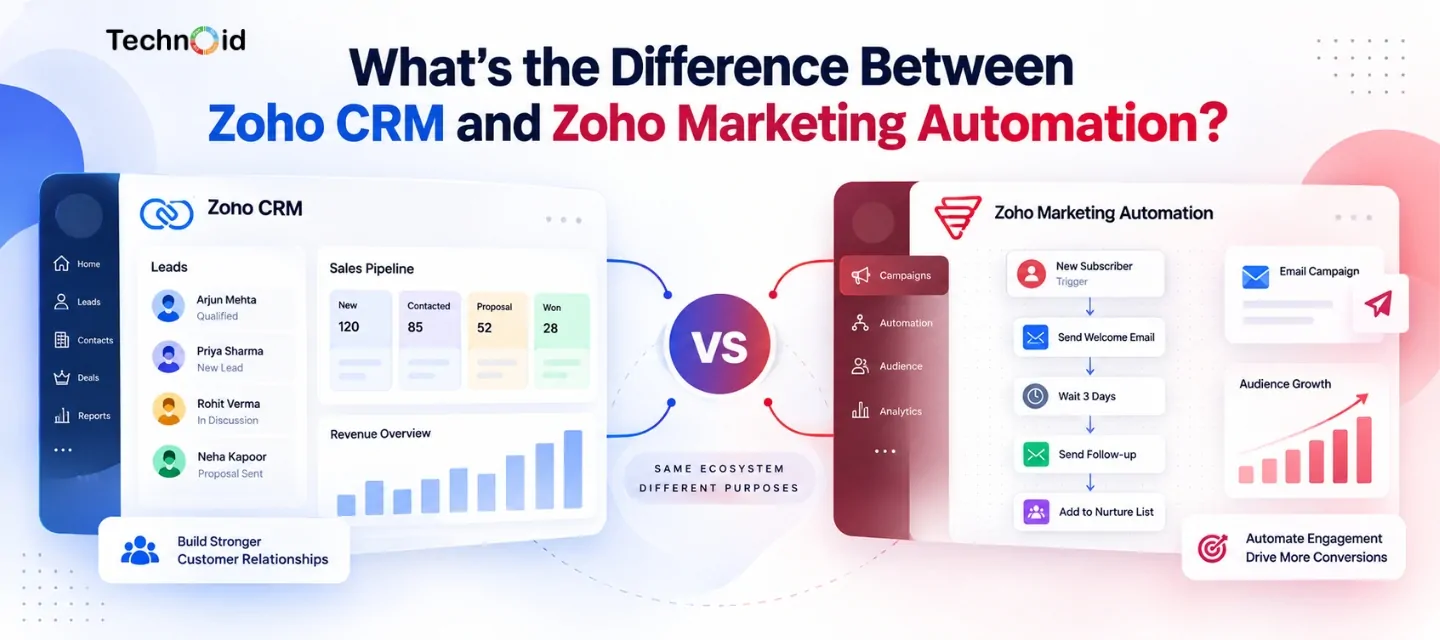
Businesses often compare Zoho CRM and Zoho Marketing Automation when looking for ways to manage customers, capture leads, and improve sales and marketing. Although both platforms are part of the Zoho ecosystem, they serve different primary purposes.
Zoho CRM focuses on sales management and customer relationships, while Zoho Marketing Automation now known as Zoho Marketing Automation, focuses on marketing automation, lead generation, engagement, and lead nurturing. Businesses can also integrate both platforms to connect marketing activities with sales processes.
Understanding these differences can help you choose the right solution based on your business goals, team requirements, customer journey, and automation needs.
Zoho CRM is primarily designed to manage leads, contacts, accounts, deals, sales pipelines, and customer relationships. Zoho Marketing Automation is designed for lead generation, campaign management, customer journeys, lead nurturing, and marketing engagement. Businesses that need both sales and marketing capabilities can integrate the two platforms to create a connected customer journey.
In simple terms:
Zoho CRM = Sales and customer relationship management
Zoho Marketing Automation = Marketing automation and lead nurturing
Zoho CRM is a customer relationship management platform designed to help businesses organize and manage their interactions with prospects and customers. It provides a centralized environment for managing leads, contacts, accounts, deals, sales activities, and customer information.
Sales teams can use Zoho CRM to monitor prospects throughout the sales pipeline, schedule follow-ups, track interactions, automate repetitive sales tasks, and analyze performance.
The platform is focused primarily on multi-channel marketing automation, lead generation, audience engagement, and lead nurturing.
It helps marketing teams understand how prospects interact with their digital channels and create automated journeys based on customer behavior. Depending on the setup, businesses can use it for activities such as website visitor tracking, email marketing, lead scoring, segmentation, campaign management, and automated customer journeys.
The primary difference is the stage of the customer journey each platform is designed to support.
Feature | Zoho CRM | Zoho Marketing Automation |
Main purpose | Sales and customer relationship management | Marketing automation and lead nurturing |
Primary users | Sales teams | Marketing teams |
Lead management | Manage and qualify sales leads | Generate, nurture, segment, and qualify leads |
Sales pipeline | Yes | Not the primary focus |
Campaign management | Supporting capability Campaign tracking and management | Core marketing function |
Customer journeys | Sales-focused processes | Marketing-focused journeys |
Workflow automation | Sales and business workflows | Marketing automation |
Customer data | Leads, contacts, accounts, deals | Marketing contacts and engagement data |
Main objective | Convert and manage customers | Attract, engage, and nurture prospects |
The two platforms can therefore complement each other rather than simply replacing one another.
The right platform depends on what your business needs most.
Choose Zoho CRM If Your Priority Is Sales
Zoho CRM may be the better choice if your business needs to:
It is particularly useful when your primary objective is to give sales teams a centralized system for managing prospects and customers.
Choose Zoho Marketing Automation If Your Priority Is Marketing
Zoho Marketing Automation may be more suitable when your business wants to:
The platform is designed to help marketers understand prospect behavior and engage potential customers throughout the earlier stages of the buying journey.
Consider a Dubai-based service business that receives leads through its website.
A visitor completes a contact form after reading several pages. The marketing team can use Zoho Marketing Automation to track engagement and place the prospect into an appropriate nurturing journey.
If the prospect continues engaging with the business and becomes sales-ready, the information can be synched to Zoho CRM based on the configured integration and workflow. The salesperson can then review the available customer information, contact the prospect, schedule follow-ups, and manage the opportunity through the sales pipeline.
In this example, Marketing Automation helps move the prospect toward sales readiness, while CRM helps the sales team manage the resulting opportunity.
Marketing and sales teams often work with different objectives, but both depend on the same customer journey.
When customer information is disconnected, teams may have limited visibility into previous interactions, campaign engagement, or lead status. This can result in duplicated work, delayed follow-ups, and inconsistent customer experiences.
Connecting CRM with marketing automation can help businesses create a more unified approach to customer management.
Benefits can include:
The exact benefits depend on how the platforms are configured and integrated within the business environment.
Before selecting or integrating the platforms, consider your:
If your biggest challenge is managing sales opportunities and customer relationships, CRM should generally be the starting point.
If your challenge is generating, engaging, and nurturing leads at scale, marketing automation may be more relevant.
If both areas are important, connecting the two can provide a more complete approach.
Selecting the right platform is only part of building an effective CRM ecosystem. Poor configuration, disconnected data, unnecessary automation, and unclear workflows can limit the value of the technology.
Professional implementation can help businesses define their requirements, structure customer data, configure workflows, establish integrations, and align the platform with existing business processes.
Technoid helps businesses evaluate and configure Zoho solutions according to their operational requirements. Through its Zoho Services in UAE, businesses can get support for CRM, automation, integrations, and other Zoho-related technology requirements.
A structured approach can also make it easier for employees to understand the system and adopt it as part of their daily workflow.
The difference between Zoho CRM and Zoho Marketing Automation comes down primarily to their roles in the customer journey.
Zoho CRM focuses on sales, customer relationships, leads, contacts, deals, and pipeline management. Zoho Marketing Automation focuses on marketing activities such as lead generation, engagement, segmentation, nurturing, and customer journeys.
Businesses with primarily sales-focused requirements may benefit from CRM, while organizations looking for advanced marketing automation may need Marketing Automation. Companies that want to connect marketing and sales can use both platforms together.
For growing organizations, the right configuration is just as important as choosing the right software. A well-planned Zoho CRM Implementation can help create a structured foundation for customer management, automation, integrations, and future business growth.
No. Zoho CRM focuses on sales and customer relationship management, while Zoho Marketing Automation now called Zoho Marketing Automation, focuses on marketing automation and lead nurturing.
Neither is universally better. Zoho CRM is better suited to sales and customer management, while Zoho Marketing Automation is designed for marketing automation and lead nurturing.
Yes. The platforms can be integrated to connect marketing activities, lead nurturing, qualification, and sales processes.
Yes. Zoho CRM can help small businesses organize leads, contacts, sales activities, customer relationships, and business workflows.
No. Marketing Automation and CRM serve different purposes and can work together as part of a connected sales and marketing ecosystem.
Yes. Zoho CRM supports automation for sales workflows, follow-ups, lead management, and other business processes.
Yes. It provides tools to capture and generate leads through marketing channels along with website tracking, campaign engagement, segmentation, and lead nurturing.
Businesses that need both advanced sales management and marketing automation can benefit from using the platforms together.
Businesses should begin by defining their requirements, sales processes, data structure, automation needs, integrations, user roles, and adoption strategy before configuring the CRM.
Generative Engine Optimization (GEO) is the process of optimizing digital content and brand ..
In Summary Search has changed more in the last two years than it did in the previous decade. ..

Do you know you can run promotional campaign, streamline your customer service operations and l ..
[calendly url=”https://calendly.com/technoidfze/30min” type=”1″]
Enjoy our content? Add us as a preferred source on Google.