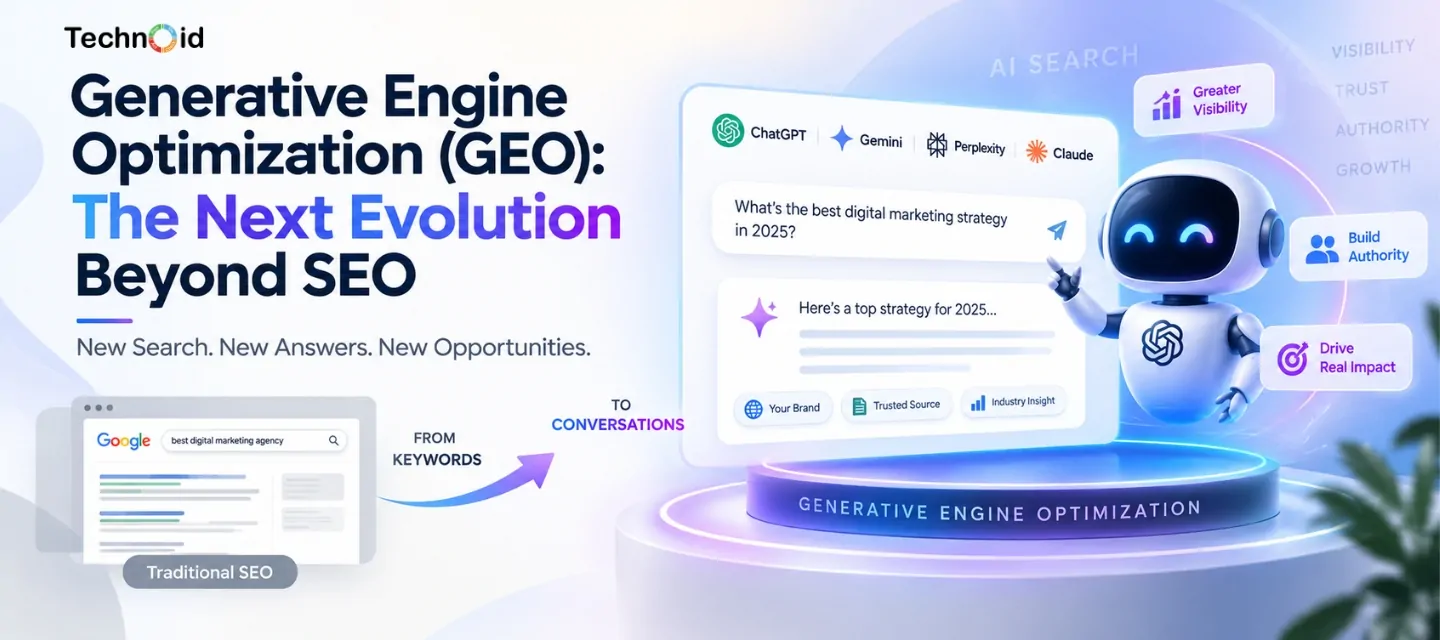
Generative Engine Optimization (GEO) is the process of optimizing digital content and brand information so AI-powered search systems can better understand, retrieve, and reference a business in generated answers. GEO builds on SEO fundamentals while focusing on conversational search, topical authority, structured information, and trustworthy content.
Search is changing from a list of links into a more conversational experience. Instead of opening multiple websites to compare information, users can now ask detailed questions and receive synthesized answers from AI-powered search experiences. Platforms such as ChatGPT, Google AI Overviews, Gemini, and Perplexity are changing how people discover businesses, products, services, and information.
Generative Engine Optimization is the practice of improving a brand’s website, content, authority, and digital presence so AI-powered search systems can better understand the information and potentially reference it when generating answers.
The way people search is becoming more conversational and context-driven. Instead of entering short keywords, users can ask complete questions such as:
These types of queries require search systems to understand meaning, context, relationships, and user intent.
AI-powered search can also summarize information from multiple sources before presenting an answer. As a result, a business can influence a potential customer’s decision even when the user does not interact with a traditional search result.
For businesses, this means search visibility is becoming broader than rankings alone. Being discovered, understood, mentioned, and referenced within AI-generated answers can become an important part of digital visibility.
SEO and GEO share many foundational principles, but their primary visibility objectives differ.
SEO | GEO |
Focuses on visibility in traditional search results | Focuses on visibility within AI-generated search experiences |
Targets keywords and search intent | Targets conversational, contextual, and intent-based queries |
Aims to increase organic rankings and clicks | Aims to increase opportunities for AI mentions and citations |
Optimizes webpages for search engine discovery | Optimizes information for easier AI interpretation |
Measures rankings, impressions, traffic, and conversions | Adds AI visibility, mentions, citations, and referral traffic to measurement |
The two approaches should not be treated as competing strategies. A strong modern search strategy combines SEO fundamentals with optimization for AI-driven discovery.
Businesses can benefit from GEO by preparing their digital presence for changing search behavior.
Optimizing content around clear questions, topics, entities, and user intent can create more opportunities for a brand to be understood and referenced in AI-powered search.
Consistent and trustworthy information across a brand’s website and relevant external sources can help establish clearer authority around its expertise.
GEO encourages businesses to address complete questions and related topics instead of focusing only on individual keywords.
Well-structured and useful information can increase the potential for a brand or webpage to be considered when AI systems generate answers.
Clear organization, semantic relationships, internal linking, and useful supporting content make important information easier to discover and understand.
As AI-powered search continues to develop, businesses that build strong content, technical, and authority foundations can adapt more effectively to changing discovery experiences.
A successful GEO strategy combines several interconnected elements rather than relying on one optimization technique.
AI-powered systems need clear information to generate useful responses. Content should address the main question directly before providing supporting explanations, examples, evidence, and related information.
Instead of creating content primarily for keyword placement, businesses should organize pages around what their audiences genuinely want to know.
A single article rarely demonstrates comprehensive expertise. Businesses can build stronger topical coverage by creating connected service pages, guides, FAQs, case studies, and supporting articles around important subjects.
Internal links should connect related resources logically, helping users and search systems understand the relationship between different topics.
AI systems need to understand who a business is, what it offers, where it operates, and what makes it relevant to a particular query.
Consistent business information, clear service descriptions, expert content, and credible third-party mentions can help establish a stronger digital entity.
AI search visibility should not depend on making content simply sound authoritative. Businesses should support important claims with evidence.
Expert authorship, original research, case studies, accurate information, credible references, and transparent business details can make content more useful and trustworthy.
Clear H2s and H3s, concise paragraphs, lists, tables, definitions, FAQs, and direct answers make content easier for users to scan and easier for systems to interpret.
Structured data can also provide search engines with additional context about webpages, organizations, services, products, and other entities.
AI SEO extends traditional optimization practices to account for how users interact with AI-powered search and how AI systems interpret digital information.
Instead of focusing exclusively on ranking a webpage for one keyword, AISEO considers the broader information ecosystem surrounding a topic. This includes search intent, semantic relevance, entity relationships, content quality, authority, structured information, and the questions users are likely to ask.
For example, a business targeting the search term “SEO company in Dubai” may optimize a service page for traditional search. An AI-focused approach can additionally provide clear information about its services, expertise, industries served, location, methodology, experience, and frequently asked questions.
This creates a more complete information profile that can serve both traditional search users and AI-powered discovery systems.
A common misconception is that GEO simply means trying to make a website appear in ChatGPT.
In reality, AI-powered discovery includes multiple experiences and continues to evolve. Businesses may need to consider platforms such as ChatGPT, Google AI Overviews, Google AI Mode, Gemini, Perplexity, Microsoft Copilot, and other emerging search experiences.
The sources selected by these systems can also change based on the query, context, location, available information, and platform. Therefore, businesses should avoid relying on a single AI platform or one optimization tactic.
A broader strategy focused on high-quality content, strong technical foundations, topical authority, and trustworthy brand information provides a more sustainable approach.
Traditional SEO metrics such as rankings, impressions, organic traffic, engagement, and conversions remain important. However, businesses should also develop ways to monitor visibility within AI-powered search.
Useful GEO performance indicators include:
AI responses can vary depending on the platform, query, user context, and location. Therefore, businesses should use consistent prompts and regular monitoring when evaluating performance.
Businesses preparing for AI-driven discovery should focus on sustainable practices rather than shortcuts.
Understand the questions, problems, and decisions behind a search instead of optimizing content around keywords alone.
Answer important questions clearly and early, then provide supporting details for users who want deeper information.
Cover important subjects comprehensively through interconnected pages, articles, guides, and FAQs.
Keep business details, services, statistics, product information, and other important claims accurate and up to date.
Ensure that search engines can access, crawl, render, and understand your website effectively.
Use credible references, expert insights, original information, transparent business details, and relevant third-party mentions to strengthen authority.
AI search is evolving rapidly, so businesses should regularly monitor visibility, identify content gaps, and update their strategies based on performance.
Preparing for AI-powered search does not require abandoning traditional SEO. Instead, businesses should strengthen the foundations they already have while adapting their content and digital presence to conversational discovery.
Start by auditing existing content and identifying pages that answer important customer questions. Expand coverage around relevant topics, improve internal linking, strengthen entity information, update outdated content, and ensure the website provides clear and trustworthy information.
Businesses should also identify the questions their customers ask before making a purchase and create useful resources that address those questions directly.
This approach creates value beyond search visibility because the same content can support customers throughout their research and decision-making journey.
The shift from traditional search to generative search creates both challenges and opportunities for businesses. A strong digital presence now needs to support traditional search engines while also being structured for emerging AI-powered discovery experiences.
At Technoid, our Generative Engine Optimization (GEO) Services in Dubai combine SEO fundamentals, content strategy, semantic relevance, technical optimization, entity signals, and AI-focused visibility strategies.
Our approach focuses on building a stronger digital foundation rather than relying on short-term tactics. By aligning website content with search intent and improving the way information is organized and presented, businesses can prepare their online presence for an increasingly AI-driven search environment.
Generative search is not making SEO irrelevant. It is changing what search visibility means.
The future of search will increasingly involve businesses being discovered through answers, recommendations, summaries, and conversations not simply through traditional blue links.
A future-ready strategy should therefore combine technical SEO, valuable content, topical authority, trustworthy brand signals, clear information architecture, and optimization for conversational search.
Businesses that focus on genuinely useful information will have a stronger foundation for both traditional and AI-powered discovery. GEO is not about trying to manipulate AI systems; it is about making a brand’s expertise and information easier to understand, trust, and reference.
No. GEO complements SEO by extending optimization efforts to AI-powered search experiences while maintaining the technical and content foundations required for traditional search.
SEO primarily focuses on improving visibility and rankings in traditional search results, while GEO focuses on making information easier for AI-powered systems to understand, retrieve, and potentially reference.
GEO can support visibility in AI-powered search experiences by improving content quality, relevance, structure, and authority, but no strategy can guarantee inclusion in an AI-generated answer.
No. GEO can apply to multiple AI-powered search and discovery experiences, including Google AI Overviews, Gemini, Perplexity, ChatGPT, and other emerging platforms.
There is no fixed timeline because AI visibility depends on factors such as website authority, content quality, competition, technical health, and the evolving behavior of AI search systems.
Yes. Small businesses can use GEO to strengthen their topical authority, answer customer questions, improve brand discoverability, and compete for visibility across emerging AI-powered search experiences.
Have you ever felt questioning yourself, “Am I doing it right with SEO?” if your an ..

Today, people are avid website scrollers more than readers. If it isn’t fast, it’s not ..

In today’s digital age, a strong online presence is crucial for any business to succeed. One ..
[calendly url=”https://calendly.com/technoidfze/30min” type=”1″]